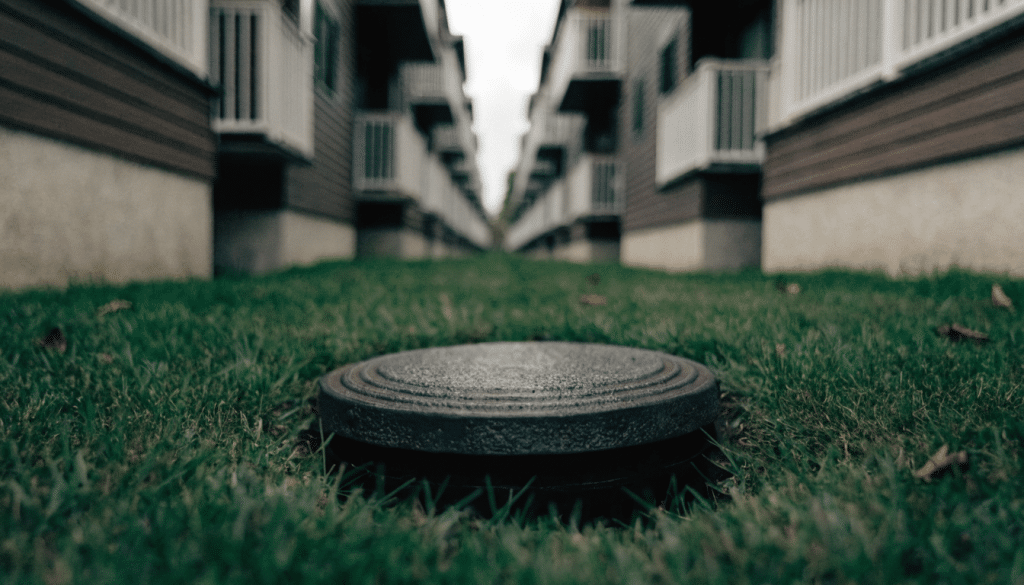
HOA sewer line responsibility splits along one line: whether the pipe serves your unit alone, or serves the building or the development as a whole. A branch that dead-ends at your unit is typically yours to repair. A trunk line running under a common area, or serving more than one unit, is typically the association’s.
The document that actually decides it, in most communities, is not state law but the CC&Rs, the association’s recorded declaration. State default rules fill the gap where the CC&Rs say nothing, but an explicit CC&R provision almost always controls first. Here is how to find the line that splits the bill, what a typical declaration says, and where the argument usually starts.
How HOA sewer line responsibility is usually divided
Most declarations sort sewer plumbing into three zones, and the further from your own walls the pipe runs, the more likely the association owns it.
- Inside the unit. Any drain line or fixture that sits entirely within your unit’s walls and serves only that unit is almost always the owner’s responsibility, the same as a kitchen faucet.
- Exclusive-use branch. A pipe that runs outside your walls (under a patio, a yard, or a shared wall cavity) but serves only your unit is usually classed as an exclusive-use common area. Many CC&Rs assign day-to-day maintenance of this zone to the owner, even though the association technically owns the ground it passes through.
- Common element. A main trunk, a vertical stack that collects waste from stacked units, or any line under shared property that serves more than one interest is a classic common element, maintained and funded by the association.
The zone matters more than the label on the pipe. A line can be called “yours” in casual conversation and still be a common element once it serves the unit next door too.
Where the answer is actually written down
Before assuming either direction, check the documents in this order:
- The CC&Rs (Declaration of Covenants, Conditions and Restrictions). Look specifically at the maintenance or repair section, not the general description of common areas. Many declarations define plumbing zones explicitly, right down to which shutoff valve marks the boundary.
- The association’s rules and resolutions. A board can adopt a maintenance policy that clarifies gray areas the original CC&Rs left open, without amending the declaration itself.
- State common-interest-development law, which supplies a default rule only where the CC&Rs are silent.
Where the CC&Rs are unclear, this is a different boundary question than the one covered in who is responsible for sewer line repair, which deals with the split between a single-family owner and the city rather than between a unit owner and an association.
A default rule when the declaration is silent
California is one of the few states with a specific statutory default for this. Under California Civil Code Section 4775, the association is responsible for repairing, replacing and maintaining the common area, while each owner is responsible for their own separate interest. Exclusive-use common areas follow a split: the owner generally maintains them day to day, but the association repairs and replaces them. The same section also makes the association responsible for restoring an interrupted water service even where the failure extends into a unit or its exclusive-use area — unless the declaration states otherwise.
That statute is California-specific and does not mention sewer lines by name; it is cited here as an example of how a default rule works, not as the rule for every state. Most states either have a different default, a less detailed one, or none at all, which is exactly why the CC&Rs carry more weight in practice than any general statute.
The parts of a declaration that matter for a sewer dispute are rarely the parts anyone reads first. Skip to the “Maintenance,” “Repair” or “Utilities” article and look for the words “exclusive use,” “common element” and “separate interest.”
If those terms are undefined or the sewer line is never mentioned, say so in writing to the board before a repair starts, not after the invoice arrives.
Situation by situation: who typically pays
| Where the defect is | Who typically pays | Why |
|---|---|---|
| Drain line entirely inside one unit’s walls | Owner | Serves only that unit, inside the boundary most CC&Rs draw |
| Branch line outside the walls, serving only one unit | Owner, under most declarations | Exclusive-use zone; association owns the ground, owner maintains what runs through it |
| Vertical stack shared by units above and below | Association | Serves more than one separate interest by design |
| Main trunk under a common area or street | Association | Classic common element, no single owner benefits alone |
| Water or sewer service interrupted by a common-area failure | Association, in states with a restoration rule | Even where the break sits inside a unit’s exclusive-use area |
Common element vs. exclusive use: the distinction that causes most disputes
Owners and boards argue past each other because they are answering different questions. An owner asks “is this pipe only mine?” A well-drafted declaration asks “does the association own the ground this pipe sits in, regardless of who it serves?” A branch line can be exclusive-use (only you benefit) while still sitting on land the association legally owns and controls access to.
That is why an association can require board notice or approval before an owner digs up a shared lawn to fix a line that is, functionally, theirs alone. The line is exclusive-use for maintenance cost, common area for excavation rights. Both can be true in the same declaration.
This is a narrower version of the arrangement described in shared sewer lines, where two single-family houses split a lateral by private agreement rather than by a recorded association declaration. The mechanics of locating the defect are the same either way.
If the suspect section is anywhere near common property, get the association’s position in writing before a contractor breaks ground. Paying for a repair the association was contractually obligated to cover is a common and largely avoidable loss.
Clearing an active blockage is different: stop the immediate damage first, then sort out whose invoice it is.
Locating the defect settles the argument
Whether a section is common element or exclusive-use is a document question. Where the defect actually sits is a fact question, and it is usually the one that ends the dispute. A camera inspection with footage distances and a surface locate tells you which side of the boundary the break is on, in a way that a verbal description from whoever answered the phone first does not.
Ask the inspector for three things before they leave: the footage distance to the defect, a surface locate marking its position over the pipe, and a copy of the raw video. All three turn “I think it’s on the common side” into something a board can act on without a second opinion.
Buying into an HOA or condo: what to check before closing
- Request the CC&Rs and any maintenance resolutions directly, not a summary from the listing agent. Read the plumbing and utilities sections specifically.
- Ask the association for its reserve study and whether sewer infrastructure is a funded line item. A common trunk with no reserve allocation is a future special assessment.
- Ask whether any unit has an open sewer-related claim or dispute with the association. Boards are generally required to disclose pending litigation and major deferred maintenance.
- Order your own inspection of anything inside the unit boundary, since the association’s reserve study will not cover it.
What tends to go wrong
The recurring failure is not a disagreement about the law, it is a repair that starts before anyone reads the declaration. An owner calls a plumber, the plumber digs where the smell is worst, and only afterward does someone ask whether that ground belonged to the association. Getting reimbursed after the fact is far harder than getting a same-day answer from the board beforehand, and some declarations bar reimbursement entirely for unauthorized common-area work.
The fix is procedural, not legal: read the maintenance section once, before there is a problem, so the first call during an actual backup is to the right party instead of a guess.
Is the HOA or the owner responsible for a sewer backup inside a condo?
It depends on where the blockage sits. A backup caused by a defect inside your unit’s own drain lines is typically yours; one caused by a common trunk or shared stack is typically the association’s. A camera inspection is usually the fastest way to tell which applies.
What if the CC&Rs don't mention sewer lines at all?
State common-interest-development law supplies a default rule in that gap, and it varies significantly by state. Ask the board in writing for its position and, for a costly dispute, have a property attorney read the declaration against your state’s statute.
Can the association bill me directly for a common-area sewer repair?
Associations generally fund common-element repairs through regular assessments or a special assessment across all owners, not a bill to one household, unless the CC&Rs specifically make an owner responsible for damage they caused.
Does it matter whether the defect is a clog or a broken pipe?
Often yes. Some declarations treat routine clearing of a line serving one unit as that owner’s maintenance cost, while a structural failure of the same section is treated as a capital repair the association funds. Check the maintenance article rather than assuming the same rule covers both.
This page describes how sewer line maintenance responsibility is commonly divided in HOA and condominium communities in the US. Actual responsibility is set by your association’s recorded CC&Rs and by state law, and both vary by state and by community. It is general information, not legal advice; read your own governing documents and consult a property attorney before a dispute escalates. See the Methodology and Disclaimer.


